Hello Beloved,
Here is another excerpt from my new book (coming soon)
(taken
from the 7 distortions section of the book)
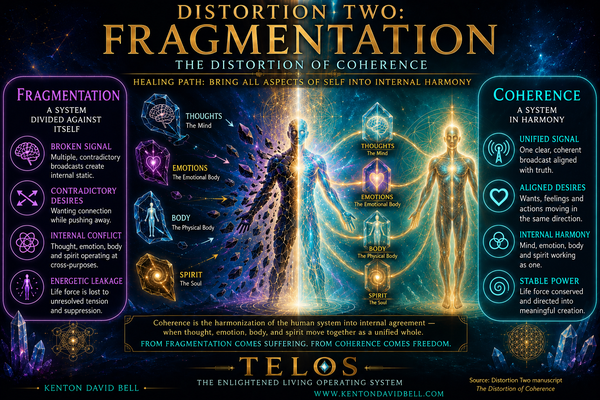
Distortion Two: Fragmentation
The Distortion of Coherence
Healing Path: Bring all aspects of self into internal harmony
Coherence is the harmonization of the human system into internal agreement — the state in which thought, emotion, body, and spirit are moving together as a unified whole rather than pulling against one another in the perpetual, exhausting friction of a system at war
with itself. When Coherence is present, the signal the being transmits into the world is clean and unified. When it is absent, that signal becomes the dissonant overlay of multiple contradictory broadcasts, each dimension of the self expressing something different, often something directly opposed to what another dimension is simultaneously transmitting. This is Fragmentation — and it is among the most widespread and most consequential distortions in the architecture of the old
paradigm.
Fragmentation is the condition most responsible for the specific and pervasive suffering of sincere people who want their lives to be different and cannot understand why, despite genuine effort and genuine intention, the same patterns keep recurring. The person in
the grip of Fragmentation is not insincere. They are not lazy, not uncommitted, not spiritually inadequate. They are simply operating from a system whose various dimensions have never been brought into genuine agreement with one another — a system that is, in the most structural sense of the term, divided against itself. And a system divided against itself cannot produce the unified, sustained, coherent output that genuine transformation requires. It produces, instead, the dispiriting
cycle of forward movement followed by collapse, of breakthrough followed by regression, of genuine progress repeatedly undermined by the part of the system that was never included in the progress.
How Fragmentation Was Installed
Fragmentation was not chosen. It was produced by the
conditions of the old paradigm with a reliability that amounts to near-inevitability. The old paradigm required the suppression of significant portions of the self as the price of social belonging and functioning. The emotional responses that were deemed unacceptable — the anger, the grief, the fear, the desire, the genuine preferences that conflicted with what the environment required — were not invited to complete their natural arc and integrate. They were suppressed below awareness, managed
into inaccessibility, or expressed only in the distorted forms that social pressure permitted. The body’s genuine intelligence was routinely overridden by the mind’s adherence to cultural norms. The soul’s genuine direction was consistently subordinated to the competing demands of an identity constructed to meet external expectations.
The result was a self that learned to present one face to the world while carrying a very different reality beneath the presentation. Not necessarily through deliberate deception — in most cases through the perfectly understandable adaptation of a being trying to survive and belong in conditions that did not welcome the wholeness of what they actually were.
The thinking mind became skilled at generating narratives of control and coherence that had little relationship to the emotional and somatic reality running beneath them. The emotional body accumulated unexpressed material that continued to operate on the system’s behavior from below the threshold of conscious awareness, shaping choices
and responses in ways the conscious mind then struggled to explain or justify. The body carried tensions and contractions that encoded years of suppressed experience, generating its own signals that frequently contradicted what the mind was directing. And the spirit — the soul’s own genuine orientation and depth of knowing — was so consistently overridden by the surface demands of the conditioned self that most people lost conscious access to it entirely.
This is the architecture of Fragmentation: not one divided self but many — each sub-system of the human organism carrying its own partially independent agenda, its own partially unprocessed history, its own response to the present moment that may have little to do with what any other sub-system is
currently expressing. The whole is not coherent because it was never given the conditions to become coherent. It was given the conditions to become functionally divided — and it adapted to those conditions with the remarkable efficiency of a species whose survival intelligence is genuinely extraordinary.
The Four Faces of Fragmentation
The fragmented individual recognizes themselves, with varying degrees of clarity, in four characteristic experiences that together describe the lived reality of a system in internal disagreement.
The first is the experience of thinking one thing but feeling another — the chronic misalignment between the mind’s position and the emotional body’s reality that the old paradigm normalized as simply the way people work. The mind says it is fine; the body is carrying dread. The mind has decided to trust; the nervous system remains braced for betrayal. The mind has committed to a direction; the emotional field is flooded
with grief about what must be left behind to take it. This misalignment is not a character flaw. It is the signature of a system whose dimensions were never brought into genuine agreement — a system in which the mind learned to operate independently of the emotional intelligence that should inform it, and in which the emotional body learned to persist in its own reality regardless of what the mind decided. The gap between what is thought and what is felt is the distance Coherence was designed to
close.
The second is desiring one outcome but acting oppositely — the maddening experience of watching oneself behave in direct contradiction to the outcomes one consciously wants. The person who wants connection but
consistently pushes others away. The person who wants abundance but unconsciously engineers financial crisis. The person who wants health but is drawn, with puzzling reliability, toward the behaviors that undermine it. These contradictions are not evidence of hidden preferences for the unwanted outcomes. They are evidence of a system in which the stated desire of the conscious mind represents only one voice among several — and the other voices, unheard and unintegrated, are transmitting their
own agenda into the field with an authority that the conscious intention alone cannot override. What the mind wants and what the system as a whole is oriented toward are not the same thing. Fragmentation is the reason. Coherence is the resolution.
The third is self-sabotage — the pattern of undermining one’s own genuine progress at precisely the moment when it becomes most significant. Self-sabotage is rarely what it appears to be from the outside: not weakness, not self-destructiveness for its own sake, not the perverse preference for failure. It is the system’s protective intelligence operating from a dimension that was not included in the conscious decision to progress. Some part of the self — shaped by old
wounds, old fears, old convictions about what it is safe or permissible to have and to be — experiences the approach of genuine success as a threat rather than a fulfillment. And from that threat response, it deploys exactly the behaviors required to restore the familiar conditions of the old identity: not because it wants to fail, but because failure, in the logic of the fragmented system, is safer than the unknown territory that success would require it to inhabit. Self-sabotage is the old
architecture defending its own survival against the genuine progress of the being carrying it.
The fourth is the persistent internal conflict and contradiction that Fragmentation produces as its ambient condition — the
low-grade and sometimes high-grade experience of being perpetually at odds with oneself, of never arriving at the settled interior agreement from which genuinely committed action can proceed. The conflicted individual knows this experience intimately: the conversation with themselves that never reaches resolution, the decision that feels right and wrong simultaneously, the sense of being pulled in irreconcilable directions by needs and values that cannot seem to be honored together. This
conflict is not the evidence of a flawed character. It is the evidence of a system whose dimensions have legitimate and unresolved claims that the overall system has not yet been brought into sufficient coherence to honor simultaneously and creatively.
Energetic Leakage and Unstable Manifestation
The TELOS framework names a structural consequence of Fragmentation that extends beyond the individual’s interior experience into the quality of their creative output in the world: energetic leakage. When the dimensions of the human system are in disagreement with one another, the energy that could be directed toward coherent creation is instead consumed in the management of the internal friction. The mental energy required
to maintain narratives that contradict what is emotionally real. The emotional energy required to suppress what the body is genuinely experiencing. The spiritual energy bleeding through the gap between the soul’s actual knowing and the choices being made in contradiction to it. All of this represents a continuous drain on the system’s creative capacity — a leak in the vessel that ensures it can never fill to the level required for genuinely stable and sustained creation.
Unstable manifestation is the natural consequence. The fragmented being may generate impressive outcomes in moments of peak alignment — when enough of the system happens to be pointing in the same direction simultaneously — but those outcomes tend not to hold, because the system that
generated them was not stably unified around them. The achievement arrives and then erodes. The relationship flourishes and then collapses. The breakthrough occurs and then slowly reverses. Not because the individual is incapable or undeserving, but because the architecture producing the result was not coherent enough to sustain it. Sustainable creation requires a coherent signal. Fragmentation produces, by definition, a contradictory one.
The Healing Path: Internal Harmony
The healing of Fragmentation is not the silencing of the system’s conflicting voices. It is the patient and genuine work of bringing them into internal harmony — of creating the conditions within which the various dimensions of the human system can be
heard, acknowledged, and progressively integrated into a whole that genuinely contains all of them rather than requiring some to be suppressed for others to function. This work is not accomplished through willpower, positive thinking, or the forceful assertion of the mind’s preferred position over the emotional and somatic reality running beneath it. It is accomplished through the honest engagement with every dimension of the system — particularly those that have been most consistently ignored —
and the willingness to allow the genuine agreement that the TELOS platform’s Coherence component delivers to emerge not through force but through the natural harmonization of a system given, at last, the conditions it was always designed to require.
Distortion: Fragmentation — the chronic internal disagreement of the human system’s dimensions, producing energetic leakage, self-sabotage, and the inability to build or sustain genuine outcomes from a divided signal.
Component Opposed: Coherence. Healing Path: Bring all aspects of self into internal harmony — engaging honestly with every dimension of the system, integrating the suppressed and the unprocessed, and allowing genuine internal agreement to emerge as the unified foundation from which coherent creation becomes structurally possible.
If you appreciate my content please consider supporting me on https://substack.com/@kentondavidbell (paid and non-paid)