Hello Beloved,
The following is an excerpt from my new book.
The Telos Thesis: The Foundational Platform of Ascended Human Architecture
This is just a small excerpt from the section THE SEVEN DISTORTIONS.
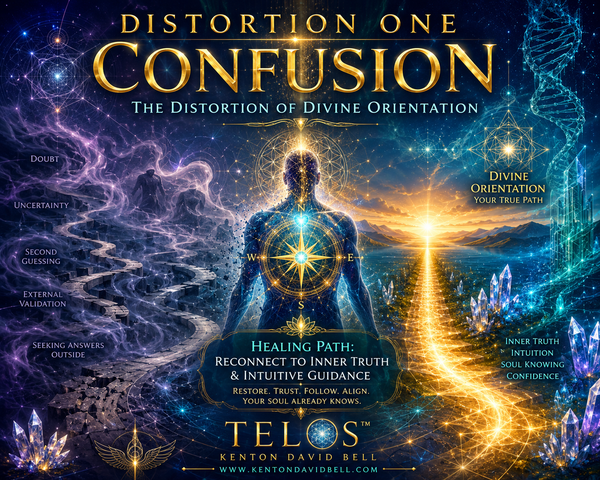
Distortion #1 CONFUSION.
The Distortion of Divine Orientation
Healing Path: Reconnect to inner truth and intuitive guidance
Divine Orientation is the internal compass — the structural alignment of the soul toward its own genuine direction, its own true path, the expression of its particular and irreplaceable design in the world. When this compass is functioning correctly, the being does not need to search for direction. They perceive it: with a quality of interior knowing that is steady, reliable, and ultimately more accurate than any external map that could be
provided. The path is not hidden from them. It is the thing they are most deeply oriented toward, the pull they feel when the noise of the conditioned mind is sufficiently quiet, the direction their whole system naturally moves when it is allowed to.
The first distortion blocks exactly this.
Confusion — the direct interference pattern opposing Divine Orientation — is not primarily the experience of not knowing which of several clear options to choose. It is something deeper, more structural, and more corrosive: the chronic condition of a being who has lost contact with their own interior compass so completely that they no longer register its signal, no longer trust it when they do, and have reorganized their entire approach to navigation around the assumption that direction must
come from somewhere other than within. It is the distortion that makes the self a perpetual seeker of external instruction in a domain where the instruction was always already present inside it.
How the Compass Was Lost
The interior compass was not lost in a single catastrophic event. It was eroded through the
accumulated pressure of an upbringing, a culture, and a civilization that consistently privileged external authority over interior knowing. From the earliest stages of development, the child who arrived already carrying the soul’s own orientation — its genuine preferences, its authentic responses, its instinctive sense of what was true and what was not — was subjected to a relentless process of redirection. The things that felt right to the interior compass were frequently overridden by adult
authority. The inner knowing that said this does not feel true was silenced by the insistence of those with power that the child’s perception was wrong, inappropriate, or simply not yet sophisticated enough to be trusted. The genuine preferences that pointed toward one direction were consistently redirected toward directions deemed more suitable, more practical, more socially acceptable, more aligned with what the family or culture required.
None of this was necessarily malicious. In most cases it was the transmission of a civilization’s own confusion — adults who had themselves lost connection to their interior compass passing along, with the best of intentions, the navigation system that the old paradigm had given them: a system organized entirely around external
reference points, external validation, and the accumulated wisdom of institutions that had long since substituted their authority for the authority of the individual soul’s own knowing. The result, accumulated across a childhood and reinforced across a lifetime, was a being who had learned, at the deepest structural level of their operative reality, that their own interior signal could not be trusted. That the answers were out there, not in here. That the reliable sources of direction were the
teachers, the traditions, the experts, the cultural consensus — anyone, in short, who was not them.
The Lived Experience of Confusion
The lived experience of this distortion is recognizable to most people, though it is rarely named as a structural condition. It presents as chronic
indecision — the inability to make choices with confidence, the constant second-guessing of decisions made, the exhausting loop of consideration and reconsideration that never reaches the quality of settled knowing that genuine orientation provides. The confused individual is not incapable of choosing. They choose constantly. But each choice carries the quality of a guess rather than a recognition — a selection made in the absence of the interior compass that would confirm it, and
therefore always vulnerable to revision the moment external opinion suggests a different direction.
The lack of direction that Confusion produces is not the absence of options but the absence of genuine orientation among them. The confused
individual often has many paths available. What they lack is the structural capacity to feel, with any reliability, which of those paths is theirs. And so they oscillate — drawn toward one direction by a momentary enthusiasm, pulled back by the doubt that follows, drawn toward another by the next external influence that promises to supply the certainty their own system cannot generate. The life that results has a quality of perpetual incompleteness: many beginnings, few genuine arrivals, a
recurring sense of having been close to something important that somehow never fully materialized.
The uncertainty of purpose that accompanies this distortion is among its most painful expressions. Purpose — in the genuine sense of a life
organized around what the soul is genuinely oriented toward and genuinely designed to express — requires the interior compass to be functional. Without it, purpose cannot be perceived; it can only be constructed. And the purpose constructed by a self without genuine orientation is always, to some degree, borrowed: assembled from the available templates of what a meaningful life is supposed to look like, shaped by the approval of those whose regard feels important, and therefore always somewhat
hollow at the center, always somewhat out of alignment with the deeper truth that the confused self cannot access clearly enough to name.
The dependence on external guidance that Confusion generates is its most visible and most persistently
self-reinforcing feature. The individual who cannot trust their own interior knowing turns, inevitably and repeatedly, to outside sources for the direction their own system cannot provide: to advisors, to teachers, to traditions, to personality assessments and astrological charts and the opinions of trusted others. Some of this seeking is genuine and valuable — external input has its proper place in any intelligent navigation of a complex world. But when it becomes the primary mode of
orientation — when the external sources are not consulted as supplements to the interior compass but as substitutes for it — the confusion is not resolved by the seeking. It is deepened. Because no external source can provide what only the interior compass can deliver: the specific, irreplaceable, soul-sourced knowing of this particular being’s particular direction. Every answer received from outside must eventually be evaluated by an interior knowing that confusion has rendered
unavailable. The seeking compounds the very incapacity it was attempting to resolve.
The inability to trust inner knowing is both a symptom of Confusion and its deepest mechanism of perpetuation. Even in those cases where the interior signal
is genuinely felt — where the compass manages to register through the accumulated noise of the distortion — the individual shaped by Confusion has been so thoroughly conditioned to distrust it that they override it. They feel the knowing and then doubt it. They register the direction and then look for external confirmation before acting on it. They wait for the world to validate what they already know, and in waiting, they lose the signal to the next wave of external input. The cycle reinforces
itself with every repetition: the more the interior knowing is doubted and overridden, the weaker its accessible signal becomes, and the weaker its signal becomes, the more the seeking of external direction intensifies.
The Healing Path: Reconnecting to Inner Truth
The healing path through Confusion is not the
acquisition of better external guidance. It is the gradual, patient, and ultimately irreplaceable work of reconnecting to the interior compass that the distortion has obscured. This reconnection does not happen through a single act of decision or a moment of dramatic insight, though moments of genuine recognition can accelerate it. It happens through the accumulation of small acts of trust: the choice, made consistently and with increasing
deliberateness, to consult the interior signal before reaching for the external one. To notice what is genuinely felt before asking what is socially recommended. To allow the soul’s own knowing to speak before the conditioned mind begins its familiar analysis.
The interior compass was not
destroyed by the old paradigm’s conditioning. It was suppressed. It was overridden so consistently and for so long that its signal became difficult to distinguish from the noise of the habituated system. But it was never severed from its source. The soul’s orientation — the genuine direction encoded in the original design of this particular being — is still present, still broadcasting, still available to be received by a system that is clearing sufficiently to hear it. The healing of Confusion
is the progressive clearing of the interference patterns that made that signal inaudible, and the progressive development of the trust that allows it, once heard, to be followed without the compulsive need for external confirmation that the distortion trained into the system.
Distortion: Confusion — the loss of contact with the interior compass and the compulsive orientation toward external direction that fills the void left by its absence.
Component Opposed: Divine Orientation. Healing Path: Reconnect to inner truth and intuitive guidance — restoring the soul’s own knowing as the primary navigational resource, and developing the trust required to follow it without waiting for the world’s permission.
If you are enjoying my content please consider supporting me on https://substack.com/@kentondavidbell (paid or non-paid)