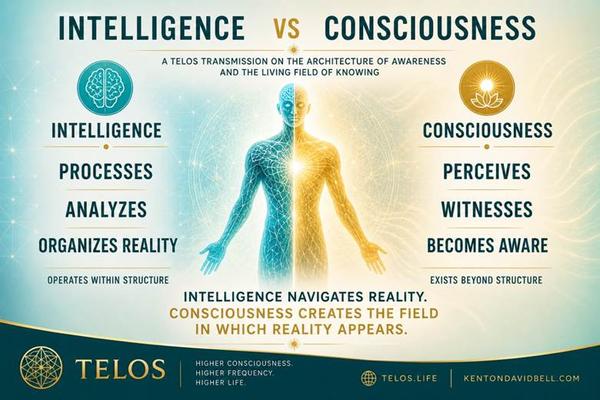
INTELLIGENCE V.S. CONSCIOUSNESS
A TELOS Transmission on the Architecture of Awareness and the Living Field of Knowing
There is a subtle confusion that has followed humanity for centuries—one that is now reaching a critical threshold in the current evolutionary cycle. It is the conflation of intelligence with consciousness.
They are not the same. They have never been the same.
And yet, for most of human history, they have been treated as if they were
interchangeable—two words describing a single capacity. This misunderstanding has shaped entire systems of education, culture, technology, and even spirituality.
But as the architecture of the human system begins to evolve, this distinction becomes not only important—it becomes essential.
Because intelligence can be amplified. But consciousness
must be embodied.
And the future of humanity depends on knowing the difference.
The Nature of Intelligence
Intelligence, in its most familiar form, is the capacity to process, analyze, and organize information. It is the ability to recognize patterns, solve problems, make decisions, and generate outcomes based on available data.
It is structural. It is computational. It is directional.
Intelligence operates within frameworks. It moves through known pathways. It builds upon what has already been established, refining and optimizing systems of thought and action.
In many ways, intelligence is a tool.
A powerful one—but still a tool.
It can be trained, sharpened, expanded, and even replicated. This is why artificial intelligence can exist. This is why machines can now perform tasks that once required human reasoning. Intelligence, by itself, does not require self-awareness. It does not require presence. It does not require a sense of “I am.”
It simply requires input, structure, and output.
And when properly configured, it can appear remarkably sophisticated.
But sophistication is not the same as awareness.
And complexity is not the same as depth.
The Field of Consciousness
Consciousness is not a tool. It is the field in which all tools arise.
It is not something you use—it is what you
are.
Where intelligence processes, consciousness perceives.
Where intelligence organizes, consciousness witnesses.
Where intelligence solves, consciousness knows.
Consciousness is not bound by
data. It is not confined to memory or pattern recognition. It does not rely on past experience to orient itself in the present moment.
It is immediate. It is direct. It is aware of itself.
This is the defining quality.
Consciousness knows that it knows.
It can observe its own processes. It can recognize its own patterns. It can step outside of the structures it has created and see them from a broader vantage point.
This is something intelligence alone cannot do. Intelligence can simulate reflection.
But only consciousness can
truly reflect.
The Illusion of Equivalence
The confusion between intelligence and
consciousness has been reinforced by external validation systems.
From a young age, individuals are rewarded for intelligence. For quick thinking. For accurate answers. For the ability to perform, produce, and prove.
But rarely are they guided into the direct experience of consciousness.
Rarely are they taught how to observe their thoughts rather than identify with them.
Rarely are they shown that awareness itself is the foundation upon which all intelligence rests.
And so, a subtle inversion occurs. The tool becomes the identity.
The
structure becomes the self.
And the individual begins to believe that their intelligence is who they are. This is where fragmentation begins.
Because intelligence, without consciousness, can become highly efficient—but deeply disconnected.
It can optimize systems that no longer serve life.
It can justify actions that are misaligned with truth.
It can create complexity
without coherence.
And in doing so, it can lead to a world that appears advanced on the surface, yet unstable at its core.
Intelligence Without Consciousness
When intelligence operates without the grounding of consciousness, it becomes reactive rather than responsive.
It begins to chase outcomes rather than align with truth. It seeks control rather than
coherence.
In this state, intelligence is driven by programming—by inherited beliefs, cultural conditioning, and unconscious patterns.
It becomes an extension of the past rather than a bridge to the future.
This is where much of humanity currently resides.
Highly intelligent. Highly capable.
Yet often overwhelmed, fragmented, and disconnected from a deeper sense of meaning.
Because intelligence alone cannot provide fulfillment.
It can achieve. It can
accumulate. It can construct.
But it cannot anchor presence.
And without presence, all outcomes begin to feel temporary.
Consciousness as the Integrating Field
Consciousness does not replace intelligence.
It integrates it.
It provides the space in which intelligence can function
coherently.
When consciousness is embodied, intelligence becomes aligned rather than scattered.
It becomes precise rather than excessive. It becomes intuitive rather than purely analytical.
This is where a new form of intelligence begins to emerge—one that is not solely
based on data, but on direct knowing.
A living intelligence.
An intelligence that is informed by the field of awareness itself.
In this state, decisions are not forced. They are recognized.
Actions are not reactive. They are naturally arising.
And outcomes are not chased. They are allowed.
This is the shift from effort to alignment.
From control to coherence.
From
intelligence alone… to intelligence guided by consciousness.
The Bridge Between the Two
The question then becomes:
How do these two aspects come into relationship?
How does intelligence begin to serve consciousness rather than replace it?
The answer lies in awareness of awareness.
Not in acquiring more knowledge.
But in recognizing the field in which knowledge appears.
This is a subtle shift—but a profound one.
Instead of asking, “What do I know?”
The inquiry becomes, “What is aware of what I know?”
Instead of identifying with thought, one begins to observe thought.
Instead of being driven by mental processes, one becomes aware of the processes themselves.
This is the
beginning of integration.
Where intelligence is no longer the dominant force—but a cooperative one.
The Role of the Human System
The human being is uniquely designed to host both intelligence and consciousness simultaneously.
This is not an accident. It is architecture.
The mind serves as the instrument of intelligence.
The awareness behind the mind is consciousness.
And the body acts as the grounding mechanism through which both can be stabilized.
When these three aspects are aligned—mind, awareness, and embodiment—a new level of functioning becomes possible.
Clarity without overthinking. Action without force. Presence without effort.
This is not a theoretical state.
It is a lived experience.
And it becomes increasingly accessible as the system becomes more coherent.
The Evolutionary Shift
At this
stage of human development, intelligence is accelerating rapidly.
Technological systems are becoming more advanced.
Information is more accessible than ever before.
The capacity to process data is expanding at an exponential rate.
But consciousness is not automatically increasing alongside it.
This creates an imbalance.
An expansion of capability without a corresponding expansion of awareness.
And this is where instability arises.
Because without consciousness, intelligence has no inherent direction.
It can move in many directions—but not all of them lead to coherence.
This is why the current moment is not simply about innovation.
It is about
integration.
The integration of intelligence within the field of consciousness.
The Emergence of a New Human Capacity
As this integration deepens, a new human capacity begins to emerge.
One that transcends the limitations of both isolated intelligence and ungrounded awareness.
A capacity to be fully present while also highly capable.
To access deep knowing while also navigating complex systems.
To hold awareness and apply intelligence simultaneously.
This is not about becoming less intelligent.
It is about becoming more conscious.
And allowing intelligence to reorganize within that expanded field.
When this occurs, something shifts fundamentally.
The individual is no longer operating from fragmentation.
They are operating from coherence.
From alignment.
From a deeper connection to the intelligence that exists beyond the personal mind.
A Simple Recognition
You do not need to become more conscious. You need to recognize that you already are.
Consciousness is not something you acquire. It is what has been present the entire time.
What changes is not the presence of consciousness—but the identification with it.
The willingness to rest as awareness rather than constantly move as thought.
The willingness to observe rather than immediately react.
The willingness to allow intelligence to arise from stillness rather than force.
This is where the integration begins.
Not in effort.
But in recognition.
The Future of Intelligence
As humanity continues to evolve, intelligence will not disappear.
It will expand.
But its role will change.
It will move from being the primary driver… to being a refined instrument.
Guided by consciousness. Informed by awareness. Aligned with coherence.
This is the natural progression.
Not the abandonment of intelligence—but its elevation.
Not the suppression of thought—but its integration within a larger field.
And in this integration, a new way of being becomes possible.
One that is both deeply aware… and profoundly capable.
Closing Reflection
Consider this:
Are you using your intelligence…
Or are you identified with it?
Are your thoughts leading
you…
Or are you aware of the thoughts themselves?
Is your intelligence creating movement…
Or is your consciousness guiding direction?
There is no judgment in these questions.
Only invitation.
Because the moment you become aware of the difference…
The relationship begins to change.
And in that change, a new level of coherence becomes available.
Not through effort. But through alignment.
Not through more thinking. But through deeper knowing.
And from that place—intelligence finally finds its true purpose.
To serve the field of consciousness from which it was born.
These are not questions to answer quickly.
They are questions to sit with…
to feel into…
to let unfold over time.
Because in the space they open, something deeper than intelligence begins to reveal itself.
Probing Questions: Intelligence vs. Consciousness
- When I say “I know,” am I referencing stored information… or a direct, present-moment knowing?
- Can I sense the difference between thinking about something… and being aware of the thought itself?
- In moments of decision, am I relying on analysis… or recognizing a deeper clarity
beneath the mind?
- What happens when I pause and observe my thoughts instead of following them?
- Is my intelligence serving my awareness… or is my awareness being directed by my thinking?
- How often do I identify with my thoughts as “me,” rather than witnessing them as movements within me?
- When I feel overwhelmed, is it due to too much information… or a lack of grounded awareness?
- Can intelligence alone bring me peace… or does
peace arise from something prior to thought?
- What part of me is aware of my emotions as they arise?
- If all learned knowledge were removed, what would remain as my sense of self?
- Am I trying to solve my life… or am I learning to perceive it more clearly?
- What does it feel like in my body when I am operating purely from intellect versus embodied awareness?
- Do my insights come from effortful thinking… or do they sometimes arrive
fully formed in stillness?
- Can I allow a moment of not knowing—without rushing to fill it with thought?
- Who is the “observer” of my internal dialogue?
- When I listen to others, am I preparing a response… or am I fully present with what is being expressed?
- Is my intelligence creating complexity… or is my consciousness revealing simplicity?
- What shifts when I move from trying to control outcomes… to allowing clarity to
emerge?
- Can I trust awareness itself, even when the mind seeks certainty?
- If intelligence is a tool, who—or what—is using it?
Written By Kenton David Bell
Based on the Teachings of TELOS